PlasticArt
The Youth Exchange was the most important and main activity that took place during this project. We carried out this project, with the following idea, because through non-formal education, experience and simulation activities and practical activities and creativity, we wanted to influence the young…
Objetivos
The Youth Exchange was the most important and main activity that took place during this project. We carried out this project, with the following idea, because through non-formal education, experience and simulation activities and practical activities and creativity, we wanted to influence the young participants of the Youth Exchange, making them understand the impact of using the plastic in the world. Participants and partners, as well as people who were directly and indirectly involved in the project, learned important notions about the use of plastic and its waste and understood the importance of cooperation, the use of creativity for arrive at a solution to the problem, and increase their awareness of the environment. Therefore, the main objective of our project was to reduce the use of plastic bags and bottles, continuing our work started with our previous project "DIY, Plastic Goodbye", given the success of this project and the positive impact that we have been able to produce.
The young participants experienced the importance of the European Erasmus + Program, and saw how much the European Union supports the initiatives of young people for education and environmental protection. The people we were in contact with during the project represented a small part of society they might encounter during their lifetime.
We young people of the informal group "Explore the World" have environmental issues at heart, but at the same time we are committed to creating awareness of global goals: humanitarianism, volunteering, tolerance.
One of the objectives of this project was to continue our collaborations with our local and international partners.
Furthermore, our informal group is in the process of setting up a voluntary association. We are formally registering, in a short time we will have a venue for our meetings and our work. Our goal is also to create a meeting point for the young people of our local community in Puglia.
The objectives of this project and the learning objectives we have achieved are:
- activate young people to protect the environment;
- create awareness of the harm of the use of plastic bottles, looking for solutions to this problem;
- promote creativity as a tool for protecting the environment;
- improve young people's level of creative skills;
- raise awareness among young people on intercultural dialogue and cultural diversity;
- increase the level of key competences of young people certified Youthpass;
- promote intercultural learning and global goals through non-formal education;
Actividades
The project consisted of 5 phases, and they were:
1. Preparation
The preparatory phase included activities which aimed to prepare the Youth Exchange when the project was approved.
2. Youth Exchange
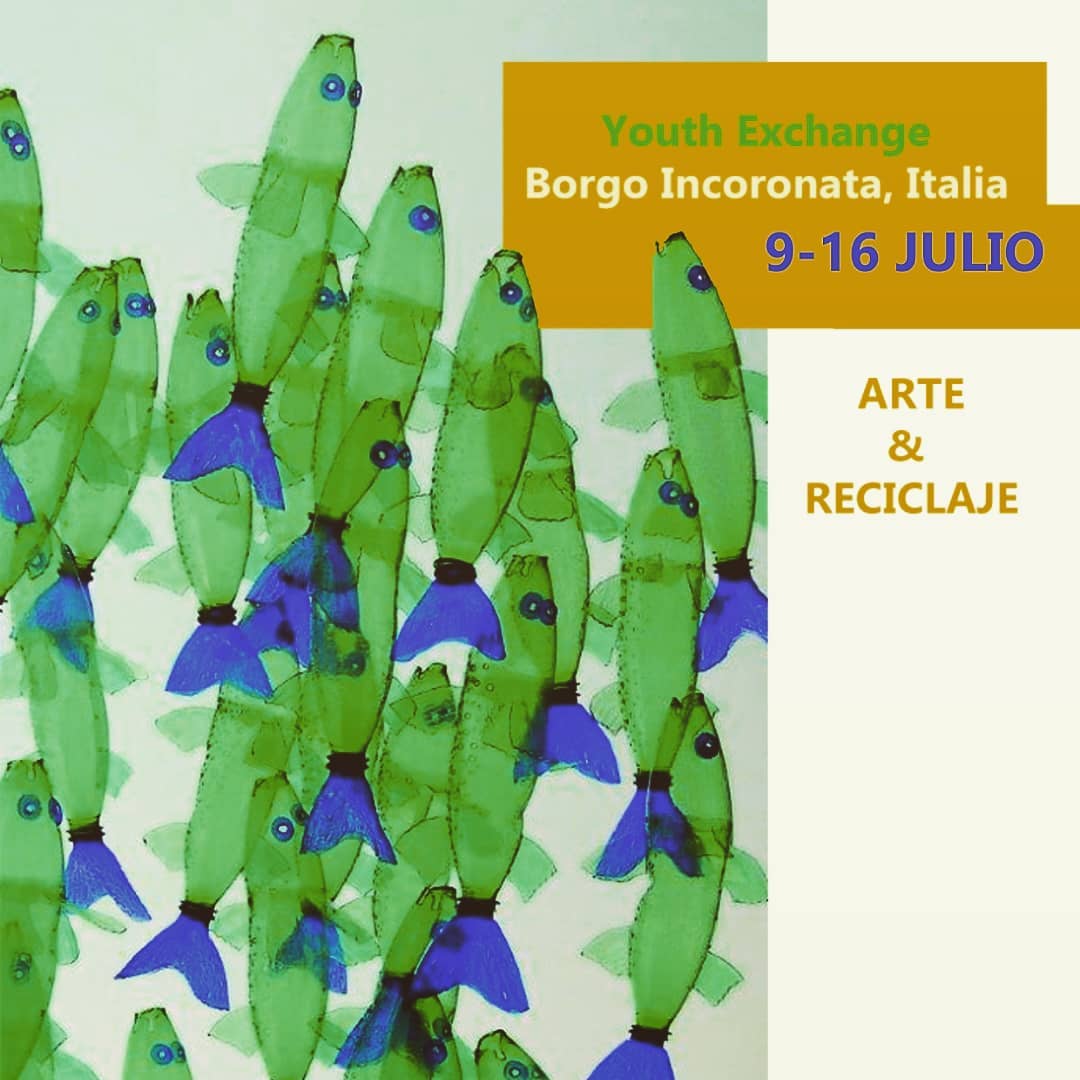
Youth Exchange "PlasticArt": 6 days of activities + 2 days of travel, in which 6 participants from each participating nation (Romania, Poland, Spain, Turkey and Italy) + 3 Italian participants (Staff) met in Borgo Incoronata to carry out the activities they organize.
In particular, the methodologies were based on experiential learning, group work, active participation, theoretical and practical inputs, team / group building activities, role plays, simulations, discussions, icebreakers, energizers, participatory and theater improvement techniques. , outdoor activities, etc. More importantly, the participants acquired practical and creative skills in recycling and reusing plastic.
The methods and activities are described in detail in the Timetable (excel file).
The common aspect of the activities in the Youth Exchange was the beginning and the end of each day. The day began with an energizer / ice-breaker, a general introduction to the day, and ended with a final debriefing and final evaluation.
Timetable:
The Youth Exchange timetable followed the following pattern. The activities are fully explained in the excel table attached to the project.
Plastic'Art Youth Exchange:
DAY 1
Arrivals of participants
First dinner and Welcome!
DAY 2
Welcome and Intro of the team & participants
Introduction
It's a pleasure to meet you!
Sharing Expectations, Fears and Contributions - Project Rules - First Daily Tree Evaluation
DAY 3
Recyling My Country and… in EU
Erasmus + Program & The Youthpass (led by Italian Team)
Damages of Single-Use Plastics (led by Romanian Team)
World Cafè "PlasticArt" + Tree Evaluation
DAY 4
Interviewing and Creating Awareness in the Local Community
Visit to Ecological Organization Legambiente
Recycling Plastic Bags Workshop (led by Turkish Team)
Continuation of Workshop + Tree Evaluation
DAY 5
What a Citizen Must / Should / Could Do (led by Spanish Team)
EU Press Release: Single-use plastics: New EU rules to reduce marine litter (led by Romanian Team)
Make Your Own "Goodbye Plastic" Shopping Bag (led by Italian Team)
Continuation of Workshop + Tree Evaluation
DAY 6
Upcycling Workshop (led by Polish Team)
Preparing the Exhibition
Final Exhibition
Final Exhibition (part 2) + Tree Evaluation
DAY 7
Future Plans
Future Plans & Planning
How did it go? - Final Evaluation
Youthpass Ceremony, Closure & Goodbye
DAY 8
Goodbye & Departure of participants
The methodologies used were the following: presentations, brainstorming, public speaking, group work, teamwork, pop-up debate, debate, creativity, sketching, upcycling, recycling, recovery of waste materials, learning by doing, etc.
These activities respected the principles of non-formal learning:
- Use of participatory methods, focused on learners to design according to the interests of young people;
- The evaluation of failure or success is never individual but collective, right to make mistakes;
- Made in environments and situations where training and learning are not the only activity;
- The learning context must put the participants at ease;
- The activities were led by learning facilitators, both professionals and volunteers;
- Activities were planned according to objectives and target specific target groups;
These methodologies chosen by us were participatory and used in non-formal education and were closely linked to the objectives that were intended to be achieved through this project - an initiative focused on the inclusion of young people with fewer opportunities, developed learning tools other than activities that they aim to educate for European citizenship.
3. Evaluation and closure
One of the most important tools that we have taken into account for our conclusions is the survey provided by the MT + portal, to which the leaders of the group participating in the Youth Exchange responded.
Impacto
In our project, our participants demolished their stereotypes, prejudices and racist behaviors. At the same time, they have acquired skills to find solutions for the environment and will be competent to conduct activities that can be created in this context and to design applications that can be created in this thematic.
Furthermore, our participants developed a common denominator in order to solve an international problem and work in this field, and were able to work in intercultural teams. They have learned about recycling systems in their countries and have been more sensitive and informed about these matters. They gained knowledge about the EU initiative and the commitments made by the European strategy on the problem of harmful plastic waste through legislative action, which was welcomed by the European Parliament and Council, citizens and stakeholders.
They were also able to achieve the following skills corresponding to the 8 key competences recognized by the Youthpass and Erasmus + program:
- Learn new concepts, approaches and terminologies of other languages, get to know different cultures;
- Be more open to people from different countries and cultures;
- Learn more about their native language by teaching their language to others;
- Learn different ways of presenting the project, making posters or flyers to promote or inform about the project, meetings and presentations for the local population;
- Improve communication with others, listen actively, express yourself, give words to your thoughts and feelings;
- Witness the meaning of humanitarianism, volunteering and motivation to be more active in the field of youth and society - the civil field;
- strengthen their interest in ecology and support volunteering at the highest possible level;
When our participants returned to their homes at the end of the project, they were able to develop a project for a social problem in their environment and at the same time translate it into an initiative, contributing to the active role of young people in society and especially in local communities. At the same time, our participants developed intercultural skills because they worked in an intercultural team.
Participants developed their knowledge and skills in the field of the environment and developed these skills to contribute to the solution of plastic pollution, such as creating an awareness campaign. Our participants developed the right attitudes to take action to solve ecological problems and raise awareness in their local communities. This impact needs to be considered more broadly.
By taking part in the Youth Exchange our participants have learned about Erasmus + and will be able to submit projects to the Erasmus + Program. This increased the visibility of the program and contributed to the personal and social development of our participants.
The target group of our project were young people aged between 14 and 30 who wanted to develop their attitudes towards social problems and the use of creative methods as a tool to solve them.
First, the participants understood how crucial it is to solve environmental problems and contribute in their daily life to improve the problem of plastic pollution. We have stressed the importance of European unity and support.
The idea that young people have not cared about their geographical difficulties, economic difficulties and stereotypes can achieve their goals.
At European and global level, through the promotion of the results of Erasmus programs people have learned about Erasmus + and other European programs and have seen what they have to offer and how important it is to visit new places and learn about other cultures and civilizations and learn a foreign language . At all levels, we can break stereotypes and prejudices and stop racist behavior.
At local, regional and national level, people have discovered the environment, ecological issues, recyclability systems in Europe and around the world, have become familiar with creative methods and have known the current situation today. .
The topic of the project is not something that only influenced Italian people, so the effect was more European and international.
Furthermore, thanks to our promotion and dissemination of project results, more people have not only been aware of the Environment topic, but have also been able to learn more about European projects, the Erasmus + program and European support for young people.
Socios
- 🇮🇹Explore The World
Italy - 🇪🇸Asociación Socio-Cultural VerdeSur Alcalá
España - 🇷🇴Asociatia "Tineret pentru Dezvoltare Durabila"
Romania - 🇵🇱Stowarzyszenie Zmiana Tematu
Poland - 🇷🇸KLUB ZA OSNAZIVANJE MLADIH 018 UDRUZENJE
Serbia
De Instagram
Co-funded by the European Union. Views and opinions expressed are however those of the author(s) only and do not necessarily reflect those of the European Union or the Italian National Agency for Youth (Agenzia Italiana per la Gioventù). Neither the European Union nor the granting authority can be held responsible for them.